

Choosing sheet metal for a home project can get confusing quickly. You might know you need steel, stainless steel, or aluminum, but then you’re faced with gauge numbers, decimal thicknesses, material differences, and questions about how easily the metal will bend or weld.
The right sheet metal thickness can make your project easier to fabricate and more durable once it’s finished. The wrong choice can leave you with material that flexes too much, weighs more than necessary, or requires equipment you don’t have. Understanding how sheet metal gauge works gives you a much better starting point.
What Is Sheet Metal Gauge?
Sheet metal gauge is a traditional system used to identify the thickness of certain types of metal. Instead of expressing thickness directly in inches or millimeters, the system assigns the material a gauge number.
The most important thing to remember is that gauge numbers work backward. With sheet steel, a lower gauge number generally means thicker material, while a higher gauge number means thinner material. For example, 12-gauge steel is thicker than 16-gauge steel, and 16-gauge steel is thicker than 20-gauge steel.
That can feel unintuitive when you’re new to buying sheet metal, so it’s often easier to check the actual decimal thickness rather than relying on the gauge number alone.
Gauge also isn’t a universal measurement across every metal. A particular gauge of mild steel doesn’t necessarily have exactly the same thickness as the same gauge of stainless steel. Aluminum can introduce additional differences, and it’s frequently specified by its decimal thickness instead.
For that reason, you should always identify both the material and the required thickness before ordering metal for your project.
Common Sheet Metal Gauges and Thicknesses
For homeowner projects involving mild steel, a few gauges appear much more frequently than others. Understanding these common sizes can help you narrow your options before you begin cutting, forming, or welding.
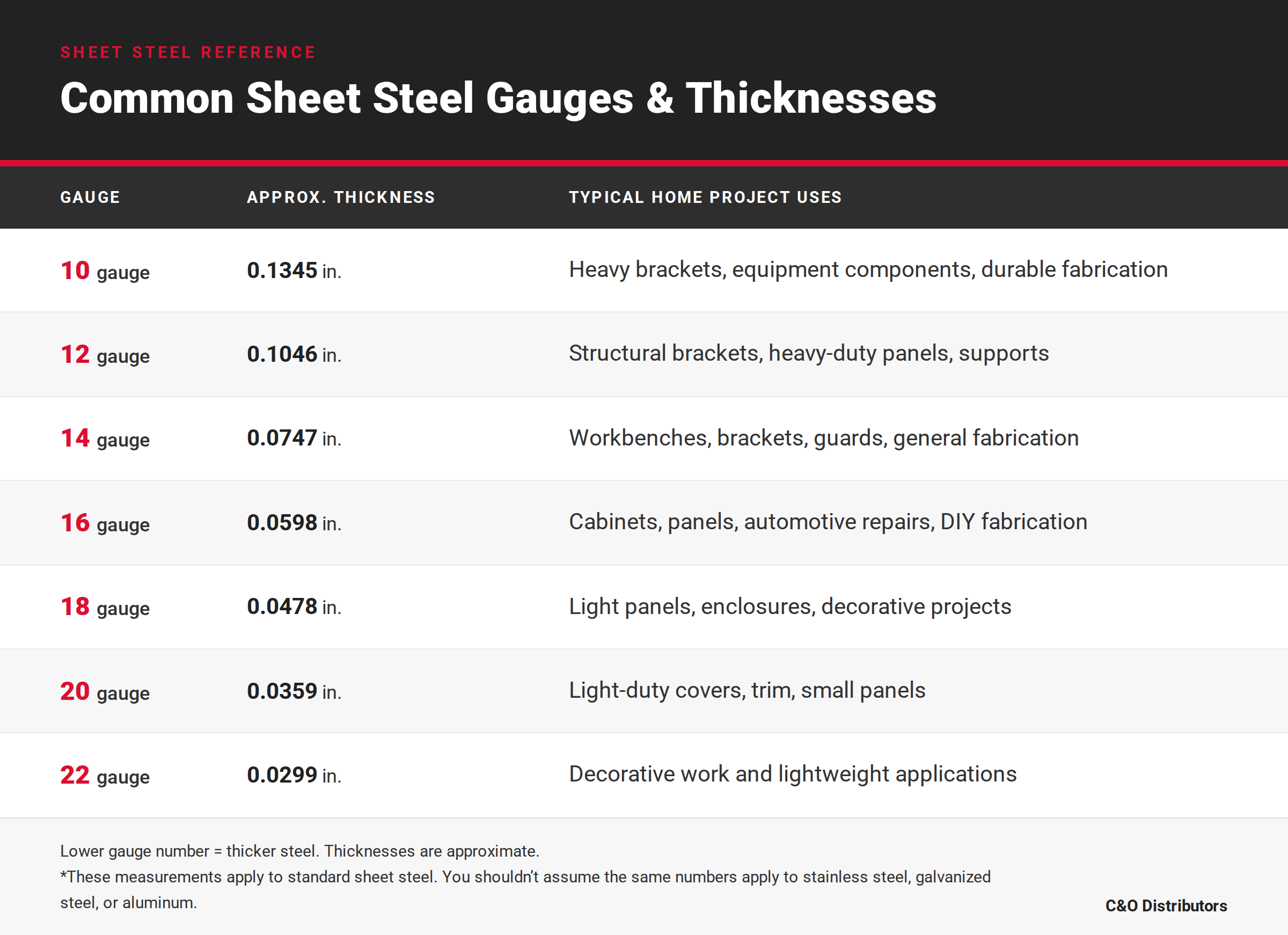
If a drawing, repair manual, or project plan gives you thickness in thousandths of an inch rather than gauge, use that measurement when selecting your material. It removes unnecessary guesswork and makes it easier to match an existing part accurately.
How to Choose the Right Sheet Metal Thickness
Picking the right sheet metal gauge isn’t simply a matter of choosing the thickest material you can afford. Your ideal thickness depends on how the finished piece will be used and how you plan to fabricate it.
Before selecting your material, consider these factors:
- Load: Will the part support weight or experience significant force?
- Span: Does the sheet have unsupported areas that could flex?
- Impact: Could tools, equipment, or other objects strike the finished piece?
- Weight: Does the finished project need to remain lightweight?
- Fabrication: Will you need to bend, roll, drill, cut, or weld the material?
- Environment: Will moisture, chemicals, weather, or heat affect the metal?
- Appearance: Does the finished surface need to remain smooth and rigid?
A decorative indoor panel usually doesn’t need the same thickness as a workbench component or equipment bracket. Selecting material according to the actual demands of your project can save money while making fabrication easier.
Thicker Sheet Metal Isn’t Always Better
It’s easy to assume thicker steel automatically produces a better project. In some applications, additional thickness provides useful strength and rigidity. In others, it creates unnecessary problems.
Thicker sheet metal is heavier and generally requires more effort to cut and form. Your existing shears, brake, drill bits, welder, or other fabrication equipment may also have material-thickness limitations.
Suppose you’re building a decorative metal cover that won’t carry meaningful weight. Moving from 18-gauge steel to much heavier plate or sheet may add cost and weight without providing a practical advantage.
On the other hand, material that’s too thin can flex, dent, distort during welding, or fail to support the intended load. The goal isn’t to choose the thickest metal. It’s to choose enough thickness for the application without making the project unnecessarily difficult.
Matching Sheet Metal Gauge to Common Home Projects
Your project’s function gives you one of the best starting points for selecting sheet metal thickness. Although the final specification depends on the design, several homeowner applications illustrate how those decisions change from project to project.
Decorative Panels and Covers
Decorative panels, wall features, covers, and similar projects generally place less structural demand on the material. A relatively thin sheet can keep the finished piece lightweight and easier to cut or shape.
You still need to consider panel size. A large unsupported sheet may flex or feel flimsy even when the same material performs well in a smaller panel.
Adding bends, flanges, ribs, or a supporting frame can increase rigidity without requiring dramatically thicker material.
Workbench and Garage Projects
Garage projects often require a balance between durability and ease of fabrication. Shelving components, equipment guards, cabinets, brackets, and workbench features may experience impacts or support moderate loads.
In these situations, 16-gauge or 14-gauge mild steel may provide a useful starting point depending on the design. Heavy brackets and load-bearing components can require thicker material.
Your frame design matters just as much as sheet thickness. Proper bends, supports, and attachment points can significantly affect how the finished assembly performs.
Automotive and Equipment Repairs
When you’re repairing an existing vehicle, mower, trailer, or piece of equipment, matching the original material thickness is usually preferable to guessing.
Material that’s substantially thicker than the original can be harder to form and weld into the surrounding metal. Material that’s too thin may not provide the intended durability.
Use calipers when possible to measure an undamaged portion of the original component. If corrosion has reduced the metal’s thickness, compare several areas rather than measuring only the damaged section.
Material Type Matters as Much as Gauge
Thickness isn’t the only specification that affects how your project performs. Steel, stainless steel, aluminum, and galvanized sheet each have different characteristics.
Mild Steel
Mild steel is a practical option for many homeowner fabrication projects because it’s strong, widely used, and suitable for common welding and forming processes.
You might choose it for brackets, workbench components, repairs, frames, panels, or general shop projects. If the finished piece will be exposed to moisture, you’ll generally need an appropriate protective finish to help limit corrosion.
Stainless Steel
Stainless steel offers strong corrosion resistance and is commonly selected when moisture exposure, cleanliness, or appearance is an important consideration.
However, you shouldn’t select stainless based on a mild-steel gauge chart. Stainless gauge-to-thickness values differ slightly, so confirm the actual thickness before ordering or fabricating your material.
Aluminum
Aluminum gives you a lightweight, corrosion-resistant option that works well for many panels, covers, enclosures, and custom projects.
Rather than depending solely on gauge terminology, aluminum sheet is often easier to select using a specified decimal thickness, such as 0.063 inch or 0.125 inch. Knowing the exact dimension also helps when you need to account for bends, clearances, or mating parts.
Our Steel Shop carries steel, aluminum, stainless steel, and diamond plate for a range of fabrication needs, giving you options when your project requires more than one material type.
Think About Fabrication Before You Buy
Your finished design may call for a particular thickness, but you also need a realistic way to turn flat sheet into the part you need.
Cutting is one consideration. Thin sheet can sometimes be handled with basic tools, while heavier material may require powered equipment or professional cutting services. Intricate shapes can introduce additional challenges because accuracy becomes harder to maintain with hand tools.
Bending presents similar limitations. A simple bend in light-gauge material may be manageable with appropriate shop equipment, while thicker sheet can require a capable press brake. Complex curves, rolled sections, and repeatable bends increase the need for specialized machinery.
C&O Distributors offers sheet metal fabrication services that include precision cutting, bending and forming, shearing, welding and assembly, and other fabrication capabilities. These services can be especially useful when your design requires an accurate finished part rather than a raw sheet you’ll fabricate entirely at home.
How Sheet Metal Thickness Affects Welding
Sheet metal thickness directly affects how you approach a welding project. Thin metal heats quickly, which increases the risk of burn-through and distortion. Heavier material can absorb more heat and may require higher output, different preparation, or multiple weld passes depending on the joint.
When you’re welding thin sheet, controlling heat input becomes especially important. Short welds, proper fit-up, suitable filler material, and the correct machine settings can help you reduce distortion.
You also need a welding process and equipment combination suited to your material. Mild steel, stainless steel, and aluminum don’t all use identical consumables, shielding gases, or welding techniques.
If you’re preparing to weld your project yourself, you can explore C&O Distributors’ welding supplies and equipment, including welding consumables, equipment, accessories, and safety products. Our team can also help you determine which supplies are appropriate for your application.
Measure Existing Sheet Metal Before Replacing It
Repairs often give you an advantage that new projects don’t: you already have a reference.
If you’re replacing an existing sheet metal component, measuring the original can give you a much stronger starting point than choosing a gauge from appearance alone. A set of calipers can measure thickness directly, provided you select an area that hasn’t been significantly worn, bent, coated, or corroded.
Remove heavy coatings or account for them when accuracy matters. Paint, powder coating, rust buildup, and galvanized coatings can affect your reading.
Once you know the approximate decimal thickness, you can compare it with a gauge chart for the correct metal type. That approach is especially helpful for garage repairs, equipment panels, guards, cabinets, and custom replacement pieces.
When Custom Sheet Metal Fabrication Makes Sense
Not every homeowner project needs professional fabrication. If you’re working with light sheet, simple straight cuts, and basic bends, you may already have everything you need in your workshop.
Custom fabrication becomes more useful when the material gets heavier, the geometry becomes complicated, or precision matters. A professional shop can also save you from buying specialized equipment for a one-time project.
Consider fabrication services when you need:
- Repeated parts with matching dimensions
- Precise bends or complex shapes
- Heavy material your tools can’t handle
- Clean circular or curved components
- Accurate holes or cutouts
- CNC-cut profiles
- A finished welded assembly
C&O Distributors’ Steel Shop provides services including shearing, forming and bending, metal punching, rolling, CNC plasma cutting, and sheet metal fabrication. That combination lets you start with the appropriate raw material and have it shaped for your project without trying to force undersized home equipment beyond its capabilities.
Avoid These Common Sheet Metal Gauge Mistakes
A few mistakes cause many of the frustrations homeowners experience when buying and working with sheet metal.
First, don’t assume a larger gauge number means thicker metal. The opposite generally applies to common sheet steel gauges.
Second, don’t use one gauge chart for every material. Mild steel and stainless steel can have different thicknesses at the same nominal gauge, while aluminum is often more straightforward to specify by decimal thickness.
You should also avoid choosing thickness based only on how strong the sheet feels in your hand. Part dimensions, bends, supports, mounting locations, and loads all affect the finished strength.
Finally, consider your fabrication capabilities before buying material. Finding out after the purchase that your brake can’t bend the sheet or your cutting tools can’t handle it can turn an otherwise manageable project into an expensive headache.
Get the Right Sheet Metal for Your Next Project
Choosing the right sheet metal thickness gets easier when you focus on the complete project rather than the gauge number alone. Consider the material, actual thickness, loads, environment, fabrication requirements, and tools you’ll need before making your selection.
C&O Distributors combines metal sales, welding expertise, and custom fabrication capabilities to help you move from an idea to a finished project with fewer complications. Whether you need raw sheet metal, precision cutting, bending, rolling, or welding supplies, our team can help you identify a practical solution. Explore our metal sales and fabrication services or contact C&O Distributors to discuss your next project.
